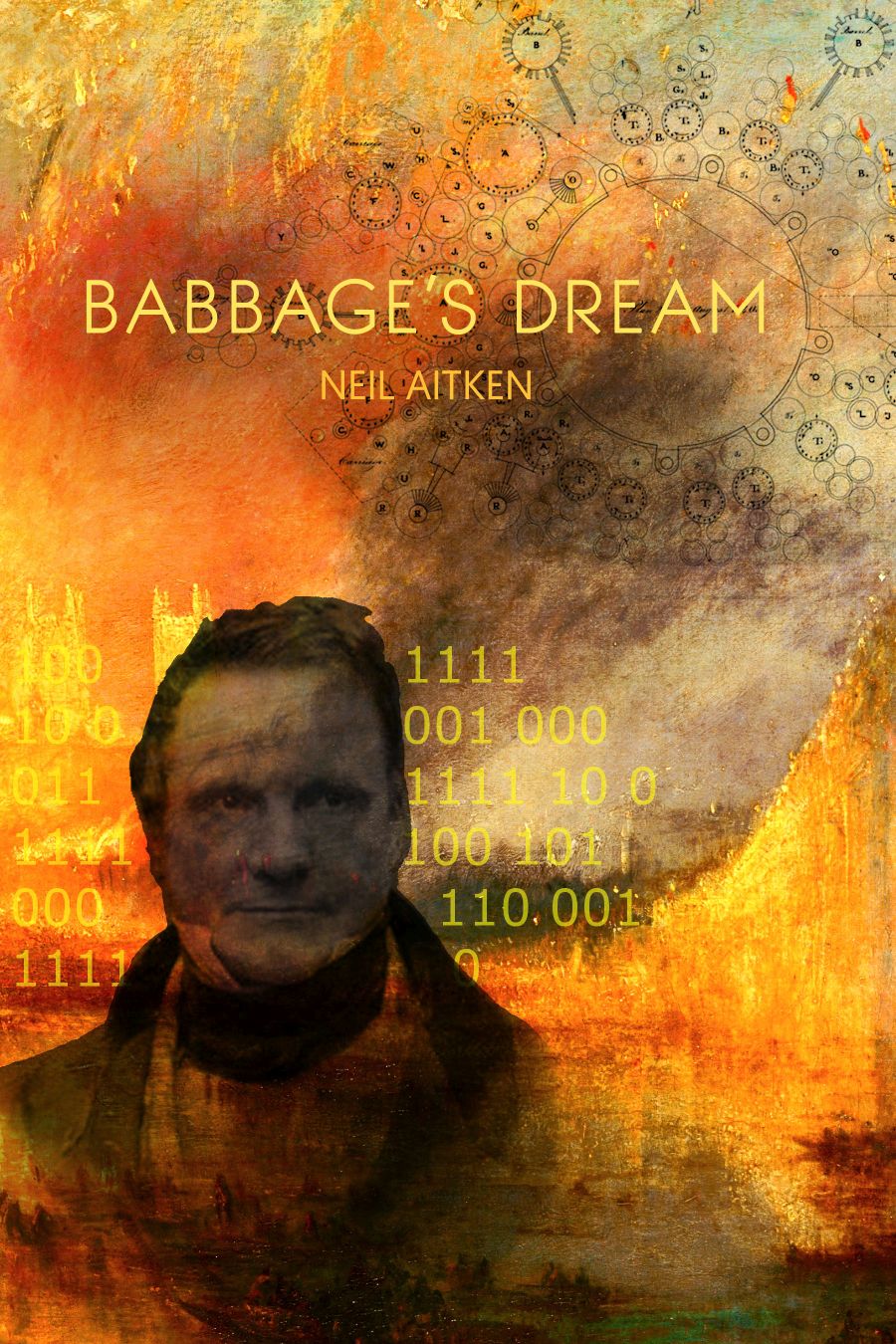
Taking its title from Charles Babbage, the nineteenth-century mathematician, who designed but did not complete what would have been the first mechanical programmable computer, Babbage's Dream weaves together not only Victorian and contemporary anxieties about the spectacle and threat of new technology, but also offers us lyric redefinitions of computer programming terms and first-person perspectives of literary and historical artificially intelligent others.
In stunningly elegant couplets, Neil Aitken transposes the dreams of machines and humans into musical, sonically deft lyrics that sing songs of creation, vision, possibility, futurity. These beautifully crafted poems—evoking the designs of nineteenth-century mathematician Charles Babbage, who conceptualized the first mechanical programmable computer—explore the tautologies between mathematics and song, science and lyric, the rational and the passionate, dystopia and hope. In the infinite tape loop of memory and imagination, Babbage’s Dream posits a Turing Test in which the reader circles both anxiously and gloriously through aspects of making, maker, and the made.
Lee Ann Roripaugh
In Neil Aitken's exquisite poems, Charles Babbage, inventor and thinker comes to life in an array of stunning images. The poems spark and leap in exhilarating assemblages as we piece together the narrative behind the concept of the programmable computer but further beyond, Aitken invites us to ask questions about consciousness, thought, and who we are in our daily lives. The jolt of the past comes back as “the bit of code we’ve let loose in the dark” and the fractals return as a heart in mourning. This is a transfixing book on memory, the human mind, and the possibility of rebirth in unexpected but musical planes.
Oliver de la Paz
From the book's first poem appropriately titled “Begin” to its last, the essence of what Aitken set out to achieve in Babbage's Dream comes full circle: to write a stunning, intelligent book of poems layered with movement—both historic and poetic—that defines the importance of duality and the creative process as that which “stirs each yes and no into a life / that will not be contained, that presses on, anxious— / always asking what is to be done, who will do it…?” (“Compile” 7-9)
Theresa Senato Edwards
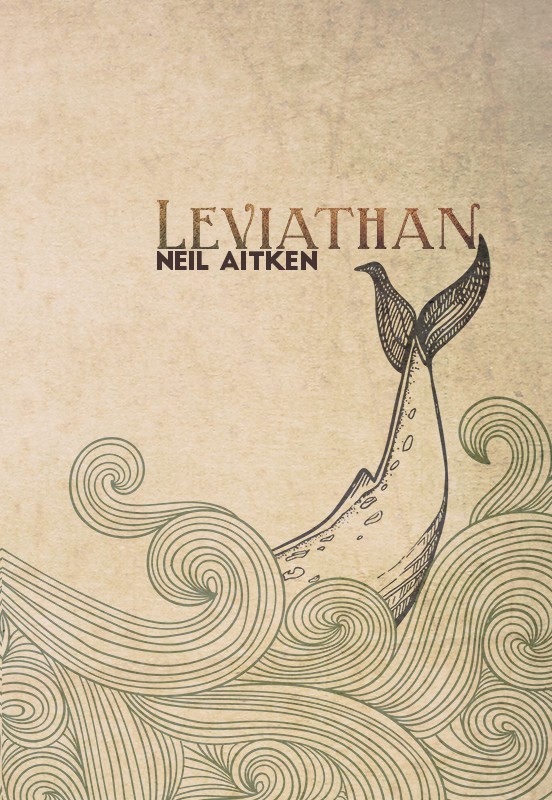
Leviathan follows the extraordinary life and losses of Charles Babbage (1791-1871), a nineteenth-century mathematician who dreamed of building what would have been the first Turing-complete computer. In his near-impossible quest which dominated most of his life, we find a resonance with our yearnings.
Neil Aitken's Leviathan offers to the extant literary conversation a new perspective of passion as it combines with the technological mind. While many contemporary essays tend to highlight the ways in which technology increases loneliness and separates us from one another, these poems manage to combine those elements in a way that brings us closer to Babbage and his loves, which in turn brings us closer to our own losses and loves.
—Julianna DeMicco, Agape Editions
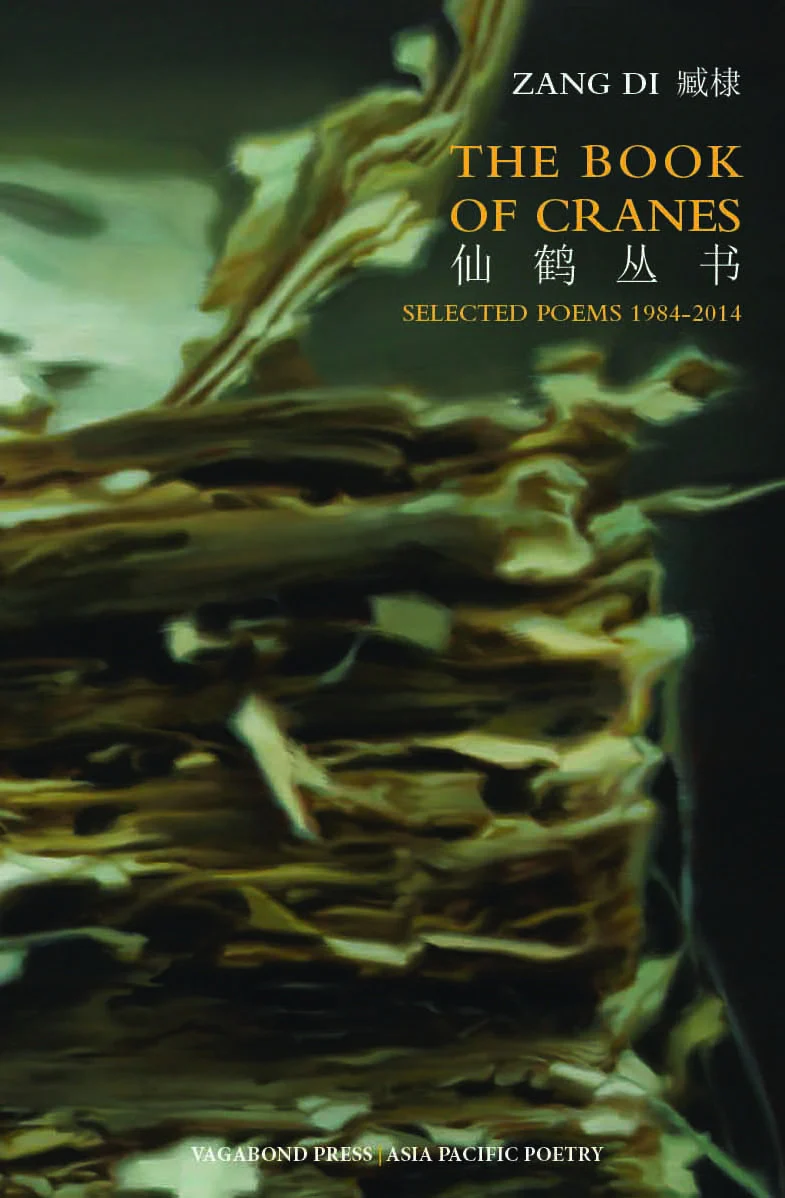
Zang Di (b.1964-) is one of the most original poets and influential poet-critics in China today, widely acclaimed throughout the country for his innovative use of language and ground-breaking critical essays that have defined a new generation after the misty and post-misty poets. Tackling a wide range of topics, his poems integrate the intellectual and philosophical with the pragmatic and earthy, constructing wildly imaginative spaces where the mind and body meet. This is the first collection of Zang Di's poetry in English translation and spans thirty years of work, from 1984 to the present. Many of his most iconic poems are included. Throughout this book, Zang Di explores what it means to struggle at the points of conflict between Western influence and Chinese classical traditions, finding that “the Du Fu in me always goes to the international post-xyz gatherings without telling the Shakespeare in me.”
This is astonishing work, hovering somewhere between the tactility of the French surrealists and the upside-down beauty of the best Chinese work: consistently surprising in thought and language, and the translations gorgeously realized
—Jeffrey Levine
The selection gives a perfect representation of an important contemporary Chinese poet who, at his best, achieves bewitching subtlety and haunting beauty. Now, thanks to Ming Di and Neil Aitken’s exquisite translation, these poems have come to life in the English language. The chronological arrangement of the poems illuminates the modulating nuances in the poet’s craft over the years, and enables the reader to see the vicissitudes of his inner life through the many transformations.
—Xiaofei Tian
Zang Di offers us a lyric moment in which the whole world stands still… I love this book “of loneliness / that persisted many years,” I love that even hatred here is mysterious, that snow bursts death. This is a book where the quiet opens: and we sit on the ruins as if sitting in a chair in the open field. It is a book of lyrics “bruised by Nietzsche,” a book where “Wittgenstein is a bird,” where even slicing cucumbers is a metaphysical exercise. Zang Di is a poet to live with, yes. But, more than that: Zang Di is a poet to pray with. For, who among us didn’t wake up one morning only to ask: “How I want to humbly kneel down, but to whom?” We are in the presence of a true spirit.
—Ilya Kaminsky
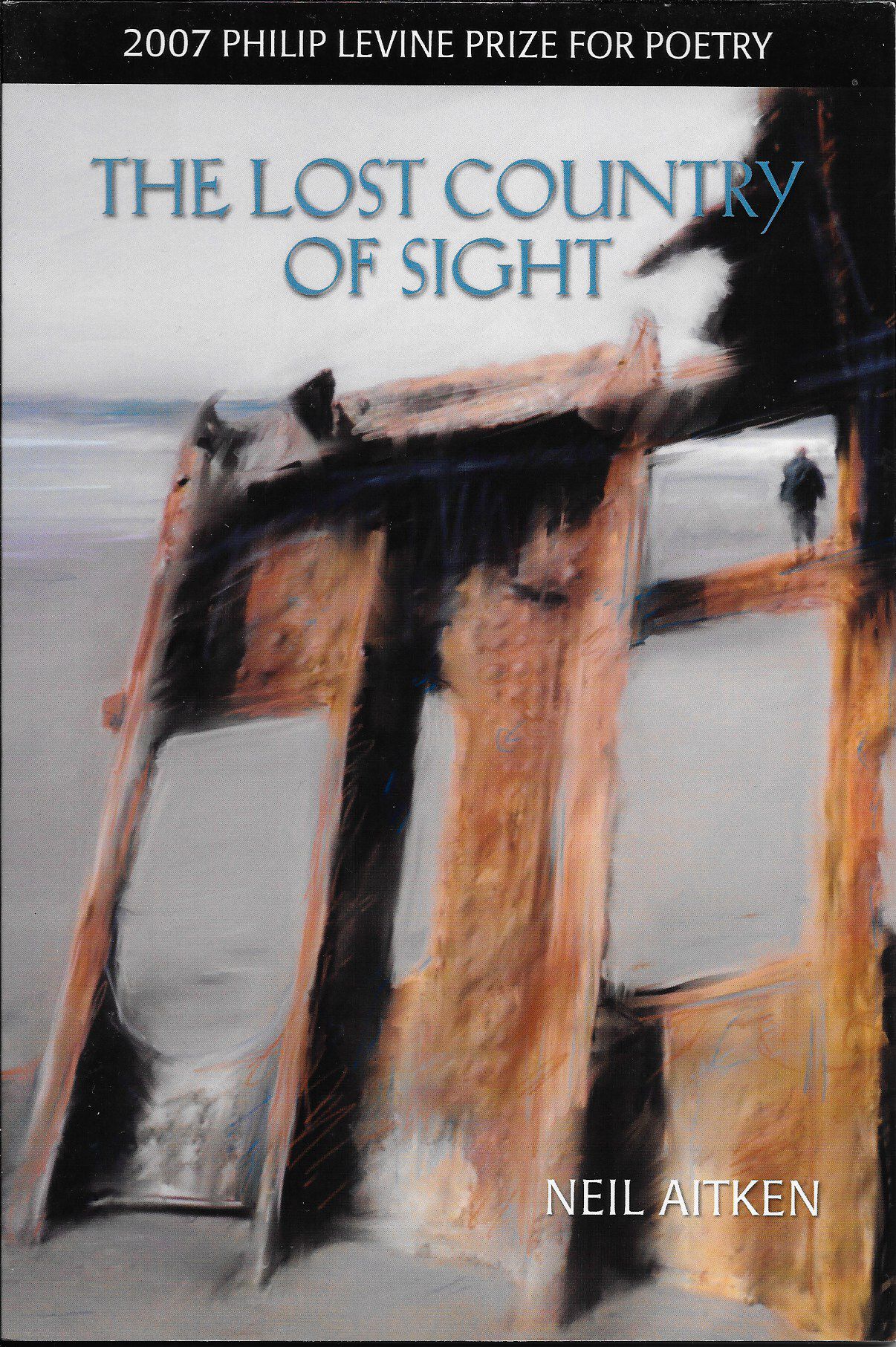
Revolving around the themes of exile and return, memory and forgetting, and the reconstruction of home through the written word, The Lost Country of Sight navigates a path through loss and separation that spans Canada, the United States, and Taiwan; the death of a father; and a life lived in the liminal space between cultures and languages.
It's difficult to believe that Neil Aitken's The Lost Country of Sight is a first book, since there is mastery throughout the collection. His ear is finely tuned, and his capacity for lyricism seems almost boundless. What stands out everywhere in the poems is his imagery, which is not only visually precise but is also possessed of a pure depth. The poems never veer off into the sensational; they are built from pensiveness and quietude and an affection for the world. “Traveling Through the Prairies, I Think of My Father's Voice” strikes me as a perfectly made poem, but poems of similar grace and power are to be found throughout the book. This is a debut to celebrate.
—C.G. Hanzlicek, 2007 Philip Levine Prize Judge
The voice in these poems is that of a sighted, awake heart discovering its home in language and its homelessness in the world. Steeped in longing, the imagination here is concrete, vivid, sensuous, and ultimately erotic, even as it perceives that meaning and beauty are evanescent.
—Li-Young Lee
Fueled by motion and emotion, Neil Aitken's The Lost Country of Sight is literally and figuratively a moving collection. His winding roads and “ghost cars” move us over the landscapes of identity and personal history with stirring meditative grace. “There is a song at the beginning of every journey” Aitken tells us in one poem even as he says in another, “these are journeys we never take.” This poet is our both our wise, wide-eyed tour guide and our dazed, day-dreaming companion in The Lost Country of Sight. This is a rich, mature debut.
—Terrance Hayes